Tuesday, May 9, 2023

Part 1: Visiting the Land of Enchantment - 9 day, 2150 mile road trip through New Mexico

Shortly after our trip to Moab, Utah we had plans to meet some friends from the Colorado jeeping group of Western Slope 4 Wheelers (WS4W) in Aztec, New Mexico searching for natural arches.  So we packed up the Grand Cherokee and we started our trip which would take us to Aztec to find arches. But...why come straight home when we could explore the rest of the state of New Mexico on the way back. So we toured Santa Fe, Roswell and Carlsbad Caverns, southern New Mexico and south eastern Arizona with a goal to find arches, geocaches, caverns, historic towns and lots of diverse scenery.

Aztec, NM

We were surprised to find out that there are actually more than 300 sandstone arches in the region surrounding the city of Aztec. Friends, Ruth and Lester  of WS4W, planned and guided our arch hunting adventure for two days.  Overall most of the arches were accessed by dirt roads which where some what 'graded' to service the oil and gas wells throughout the area. Some arches could be seen from the road and others required short hikes. We found about 23 named/numbered arches that were on our guide list and 15 arches that we called our bonus arches (not on 'the list'). In two days we would travel down Potter, Hart, La Manga, Pump and Pilares Canyons in our quest to find arches and... indeed, we found arches.

First, what is classified as an arch. As defined by the Natural Arch and Bridge Society, "a natural arch is a rock exposure that has a hole completely through it formed by the natural, selective removal of rock, leaving a relatively intact frame.". So what you will see, are many different types of arches and below is a just some of the arches that we found. 

The Colorado mountain range as a beautiful back drop

Jeep lineup of the 'Arch Hunters'

Hart Arch

This arch labeled NM-031 was a pretty tough hike to get the close up photo. Extra bonus was that we found a geocache in a nearby tree. 

Happy arch hunter and geocacher. We continued hiking to Arch NM-040 which was about 24ft in length and 7ft high.


Another photo of NM-040 from afar.

Little Delicate Arch

Saddle Horn Arch in Pilares Canyon

Outcrop Arch in Potter Canyon


Pillar Arch


La Manga Arch in La Manga Canyon

Our guide, Ruth, peeking through Drum Stick Arch

Before we departed Aztec in route to Santa Fe we visited the Aztec Ruins National Park. This massive stone structure settlement was engineered and built by ancestral Puebloans between late 1000s to the late 1200s AD. Our self guided tour along with audio narration gave us the history and detailed information on the structure and uses of each building. The buildings were mostly made of stones, mud mortar, sandstone masonry exteriors and wood roofs and consisted of over 400 rooms, ceremonial and public buildings.

Brochure photo of overall settlement

Looking across the edge of a ceremonial kiva and the living rooms in the back ground

The doorways were short - even for Deb.


Inside the Great Kiva (excavated in 1921 and rebuilt in 1934).


The wood found in place supporting the roofs in this darker area of the rooms is the original wood, that is a thousand years old.

One of many rooms displaying matates
 (a ground stone tool used for processing grain and seeds)

Great memories were made with friends. We thoroughly enjoyed visiting the Aztec Ruins and the arches in the Aztec area and hope to go back and find a couple more someday.  Now it's on to Santa Fe for a couple of days.

Santa Fe

There seems to be a common word to describe Santa Fe - 'Oldest'.  Santa Fe is the oldest capital city in the United States and the oldest European community west of the Mississippi.  We visited the De Vargas Street house which is the oldest house in the US and also the San Miguel Chapel, a Spanish colonial mission church built in 1610, is referred to as the oldest church in the US (excluding Puerto Rico).  The history is abundant in Santa Fe Historic District where we spent most of our day exploring.  We had one full day and it wasn't enough to thoroughly visit all the history, arts, museums, etc.  If you like adobe buildings you will like Santa Fe.  This will be another place we will need to come back to to explore even more.

The Oldest standing/occupied House in United States. Exact year built is unknown but noted as 1692.

San Miguel Church - Oldest Church structure in US. The original adobe walls and altar were built by Tlaxcalan Indians fro Mexico under the direction of Franciscan Padres in 1610


Interior of oldest Church


The Cathedral Basilica of St Francis of Assisi built in 1869

Interior of The Cathedral Basilica
Loretto Chapel built in the 1870's. Today it is known for the legend about it's beautiful and miraculous staircase
 
Internet photo of interior of Loretto Chapel showing the self-supporting wooden staircase.

We read that Santa Fe is known for its diverse and plentiful arts. Artists first began to migrate to Santa Fe in the late 1800s drawn to the landscape, the culture and the adobe architecture. This trend never really stopped and the city has centered a lot of the tourism around the arts. It would take days to really enjoy seeing all the different art districts in Santa Fe.

Art is almost on every corner.  We thought this sculpture was fun and had a good message.
You Can Do Anything * Make Every Day Count * Count Your Blessings * Always Believe in Yourself


Pioneer woman

Large 'kachina' statue outside native American arts center


Once again it's time to move on down the road.  Next stop will be Roswell and Carlsbad Caverns. So stay tuned for the second half of New Mexico. 

Happy Travels,

Jack & Deb


Thursday, April 20, 2023

Spring Flowers and Easter Jeep Safari

Spring Flowers:

Our winter has been a very wet one with Arizona receiving record amounts of rain and the higher areas getting record snow falls.  All this moisture almost always guarantees an abundance of Spring desert flowers and we weren't disappointed.

Globemallow

Mexican Poppy


Desert Chicory
Field of Mexican Poppy and bluedick.
Bladderpod
Globemallow

Brittlebush


Easter Jeep Safari:

In between Spring flower viewing and local off-roading, we also prepared the Jeep and motorhome for the annual trek to Easter Jeep Safari in Moab, UT.  This was our 11th year attending the event but this gathering has been going for 57 years. It is organized by the hard working members of the Red Rock 4-Wheelers club. There are over 35 different 4-wheeling trails to choose from ranging from beginner to extreme terrain. We enjoy going to run some of the trails, see the beauty of the area, look at all the different types of Jeeps, vender show and meet up with friends. 

Our route usually takes us through Flagstaff, AZ with our first overnight stop in Bluff, Utah. The Bluff area offers beautiful scenery, history and interesting sights. This year we explored West of Bluff to nearby Mexican Hat and to the start of Monument Valley just to peek into the Valley and get a geocache. Yes, this the spot where Forest Gump stopped his cross country run and said "I'm pretty tired... think I'll go home now".    


 Monument Valley - This photo was taken from the roadside pullout because we didn't want to stand in the middle of the road dodging cars speeding by to take the photo!!! 

Mexican Hat formation near Mexican Hat, Utah.


Unique rock formation called Church Rock but it sure looks like a bee hive to us.

Once we arrived at our RV spot for the week in Moab we were in awe of the snow capped La Sal Mountains out our RV's front window.


La Sal Mountains, Utah

View from our RV site of the snow covered La Sal Mountains

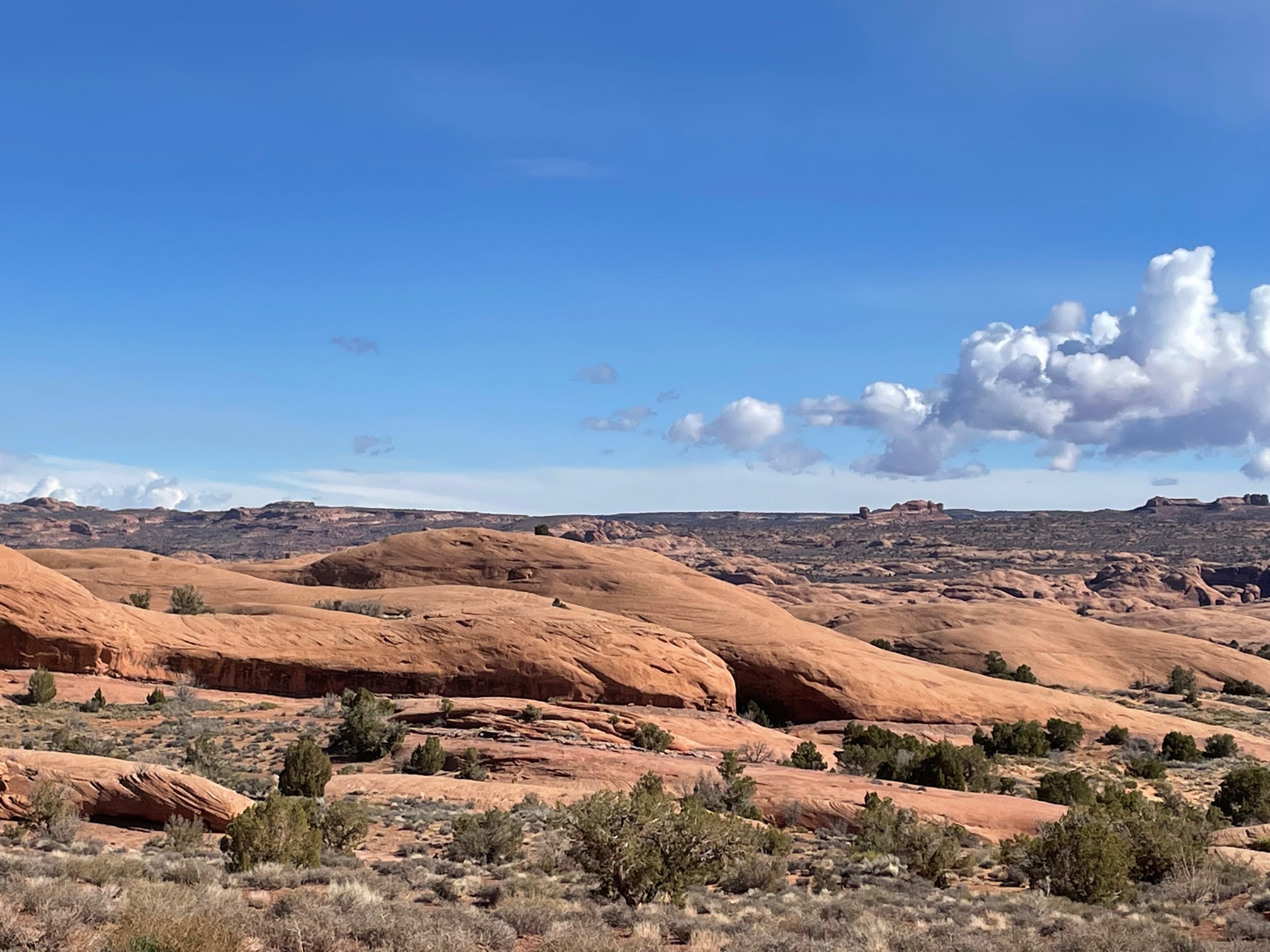
View of the Moab red rocks and La Sal mountains in the background.


View from motorhome window.

We had a couple days to do some touring on our own before we attended our scheduled trail runs for the week.  So I talked Jack into some geocaching and shopping. The geocaching took us to some places we had not explored yet; like some unique caves.  YES... The Geocache app said there was a cache to be found in these caves! Sources state that the caves were first dug in the 1950's to be a house but was abandoned and unfinished. Later they were to be used as movie sets in the Indiana Jones movie.  So equipped with flashlight, cell phone and ink pin we ventured into the unknown to find the cache and take a look inside the caves. We were happy to log a First To Find (FTF) cache at this location. So, we were successful without fighting off tomb raiders or snakes and the walls did not close in on us once we removed the treasure from its hiding spot.  Plus, it was fun to just explore the caves.


Caves cut into the sandstone.

View from inside cave looking down at our Jeep and the beautiful red rock.


Interior rooms of cave.


After caving we went on another geocache hunt that brought us to some historical graffiti from the 1900s and petroglyphs from native Americans around 1200s . If these walls could talk I wonder what they would say. 


Trail #1:  Tip Toe Through Hell

Our first EJS event trail was picked and driven by Deb, which runs (tip toes) through the premier trail of Moab... 'Hell's Revenge'.  This trail had long stretches of sandstone slick rock with steep climbs and descents with some narrow edges that made for some slightly sweaty hands while driving.  LOL  Once we crested some of the slick rock we were greeted with large vistas of the snow capped La Sal Mountains, Arches National Park plus the cliffs overlooking Moab Valley.  We thoroughly enjoyed driving this trail.


Typical Hell's Revenge driving terrain

Red Rock views abound

Trail #2: Hey Joe Canyon

Hey Joe Canyon is a trail that meanders on the ledges of Spring Canyon, Labyrinth Canyon  and next to the Green River.  The trail starts at the top of the canyon and transverses ledges (single lane shelf road) until we were right next to the river and then went 9 miles up river.  There were several fallen rock obstacles where we had to go over because we were on a trail that has a canyon wall on one side and the river edge or cliff on the other and no where to go around. The trail ended at an old Uranium mine area dotted with old equipment and remnants left behind from the 40's/50's.

The muddy Green river

An old air compressor powered by a straight 6 CAT engine mounted on a towable steel wheel cart.

Found a fixer upper truck

Hooray  we were able to spot Desert Bighorn Sheep as we were exiting the trail.
Perfect way to end the day.

Trail #3: Cliff Hanger 

This trail was a bucket list trail for Jack. This is one of the longest and toughest days we have had since 4-wheeling in Moab. Forewarned some Jeeps were damaged on this trail. Luckily, we only sustained minor fixable damage (bent tie rod bar).

The trail started instantly from the roadway where you had to maneuver down rock ledges and then almost immediately after that we were faced with a large boulder wall to get up and over.  From there it seemed like a consistent series of obstacles that tested the ability of rigs and drivers.  The actual Cliffhanger obstacle was a big ledge on a narrow shelf trail overlooking Jackson Hole some 1000 feet below. Yes it was tough going down and tougher going up on the way out. The trail ended at a spectacular overlook of the Colorado River and miles of red rock and mountains scenery. We enjoyed our lunch, took in the scenery and then packed up and made the return trip over all the obstacles we had battled coming in.  Testing the 'rock sliders' and skid plates the whole way.


The first 3 foot ledge to get up 

Another rock face to climb

As we climbed the canyon walls to the mesa top, the scenery was getting better 

Just getting to the top was the hard part

About to test the rock sliders and trying to keep from getting high centered (turtled) 

Up on top...what can I say just look at this view!

More of the red rocks of the Moab  

Heading up the 'Cliffhanger' obstacle

Getting some 'flexing' in

Going down the 3 foot ledge is easier.

One of the final tough rock crawls to get off the trail
 (the rear wheels just pulled up out of a 4 foot deep pit)


So that's a wrap - We enjoyed our adventure in Moab and plan to return next year. 

Happy Travels,


Our Jeep was 'ducked' while in Moab. What does it mean you ask. It is an act of kindness where Jeep owners place rubber ducks on other Jeeps to let them know that they have a nice Jeep. Simple concept but sure brings a smile to your face.